AuthorMike Reeves Fayette County TN. County Commissioner, District 6 Position 1 Archives
August 2025
Categories |
Back to Blog
Is it Factual News or Biased Propaganda?8/12/2025 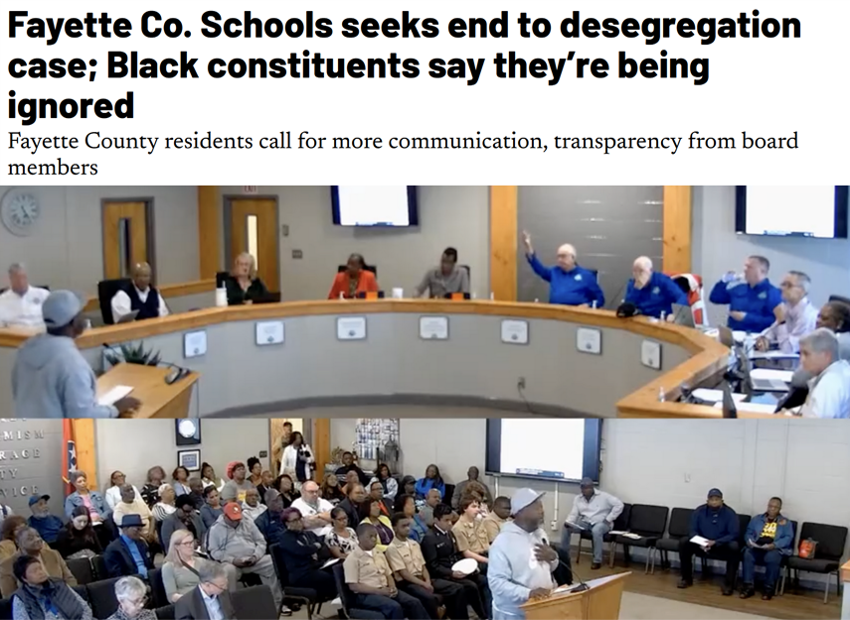 A News Story or Propaganda Recently an article was published in a regional media site titled "Fayette Co. Schools seeks end to desegregation case; Black constituents say they're being ignored." The article walks through a number of issues, and as the article progressed, it became obvious that it was written in a manner that methodically and deliberately leads to a conclusion that the new school board and administration is not acting in the best interest of Fayette County Public Schools (FCPS). An infamous propagandist once said, "That propaganda is good which leads to success, and that is bad which fails to achieve the desired result. It is not propaganda’s task to be intelligent, its task is to lead to success." There is truth in that quote, which applies to the article. But, to simplify the understanding of the quote, one needs to understand the difference between journalism and propaganda. Let me quote a Bible verse to set up the explanation: "Woe to those who draw iniquity with cords of deceit and pull sin along with cart ropes...Woe to those who call evil good and good evil, who turn darkness to light and light to darkness (Isaiah 5:18,20)". With that, here is a simple delineation between journalism and propaganda: "Journalism is presenting truthful facts from a position of neutrality. Propaganda is presenting distorted facts through the lens of an agenda." As I read the article, I found there was missing information, inappropriate context, inaccurate representation of facts, and insinuations that led to an incorrect perception of the new school board and administration. The article also inferred that FCPS is only for minority students, which is not the case. While there is a majority of minority students, that doesn't mean that only minority students should be considered in FCPS educational and policy decisions. To be clear, educational systems must be about quality education, not social justice. It is difficult to accurately present the summation of 60 years at FCPS under the consent order; however, writing an article with limited historical knowledge, having received input from only a few heavily biased individuals, or by viewing only one or two board meetings is, at best, imprudent. Therefore, it is appropriate to provide some additional context, proper factual references, and supplemental information to provide a correct perspective of the new school board and administration. Budget Responsibility State law places responsibility for the budget on the "Director of Schools" which, in FCPS's case, is the superintendent. This is definitively stated in T.C.A. 49-2-301 - Director of Schools. Therefore, the argument in the article regarding a "budget director" is inaccurate according to state law. The superintendent is responsible for preparing a budget, and the board approves or disapproves of budget items, including positions and salaries. Nowhere in Tennessee Code Annotated is the public included in the process of budgeting. The budget is public record, but the development of the budget is the sole responsibility of the superintendent, and the approval of the budget is the responsibility of both the School Board (local board) and the County Commission (local legislative body). In short, the board has one employee, the superintendent, and the superintendent is responsible for the budget. Funding, Federal vs. State vs. Local Funding, along with loss of control, has been the crux of recent conflict in the FCPS community. Many from the previous board and administration expected the county to fill the funding gap for state and federal (ESSER) funding that was reduced or eliminated. This wasn't possible, as it would have required as much as a 50% increase in Fayette County property taxes. To clarify funding, one needs to understand who is responsible for funding and how funding works. The Tennessee State Constitution has placed free public education under the purview of the General Assembly. Article XI, Section 12 states, "The General Assembly shall provide for the maintenance, support, and eligibility standards of a system of free public schools." The state uses the Tennessee Investment in Student Achievement (TISA) funding model to determine funding for FCPS, and that funding is generally based on the number of K-12 students in the school system. The state also dictates how much the county must contribute to FCPS as part of that funding model. FCPS has lost 600+ students in the last few years because of the declining quality of education, which equates to a loss of at least $4,238,400 in TISA funding. In 2015, there were about 3,600 students in FCPS. In the ten years following 2015, FCPS maintained administration as though the number of students had not changed. This, coupled with the loss of state and federal funding, has forced the new administration to streamline administrative functions and optimize classroom sizes to better utilize teaching resources. Consent Order Budget ImpactBecause of lower state funding, the money required to satisfy all the reporting for the consent order must be taken from educational funding. Further, things like closing schools with only 152 students is off the table, even though there is a new school with capacity for more than 300 students in the vicinity. Because of the order, the older school cannot be closed without judicial consent. These demands cost FCPS millions of dollars, resulting in a 2025-2026 budget shortfall. That forces FCPS to draw from fund balance, thus depleting reserve funds and putting the school system on a trajectory that could result in bankruptcy. Financial ManagementSchool finances and financial management have been a serious concern with FCPS for many years. Spending on administrative salaries under the previous administration was not in line with the rest of the state. FCPS spent a higher percentage of the budget on administration and a lower percentage of the budget on instruction than any school system in Tennessee. Further, the previous school administration had no qualms about violating state law for their own convenience. In the 2023-2024 school year, the county commission rejected a "clean-up" budget amendment presented by the FCPS Finance Director. In that amendment, more than $800,000 was spent from the fund balance without prior authorization from the School Board and the County Commission. Changes to the budget must be approved by both the board and the commission prior to making the change. This was a clear violation of state law in both T.C.A. 49-2-301 - Director of Schools and T.C.A. 5-9-407 - Budget amendments. This misdeed resulted in serious audit items lodged by the State Comptroller's Office, and ultimately, the Finance Director's contract was not renewed. Capital Projects vs TeachersAs previously mentioned, the primary function of an educational system is education. In 2022-2023, the previous board allocated $1.8 million from fund balance to renovate the football facilities. At the time, there were 17+ classrooms in FCPS without teachers. During that meeting, a board member, now chairman of the board, voted against the motion and made a motion to use $1 million from the fund balance to give teachers a raise. The motion did not receive a second, so there was no vote, even though the board knew there would be more than $1 million in unbudgeted sales tax to replenish the fund balance. All the while, students in classrooms had to endure "virtual learning" because neither the administration nor the board prioritized putting teachers in the classrooms over football facilities. School BoardThe people of Fayette County elected the school board to change the trajectory of education and rein in spending at FCPS. FCPS is ranked at or near the bottom educationally in Tennessee, which affects property values and businesses considering relocation to the county. This board answers to all taxpayers of Fayette County, not only to minority interests in the school system. Taxpayers, all of them, are stakeholders, and the board, while it must follow appropriate laws and regulations, answers to the taxpayers. School boards authority is granted under T.C.A. 49-2-203 - Duties and powers. Due to death or illness, two seats from District 2 were vacated and subsequently filled, through appointment, by the county commission. In the 2024 election, District 2 voters, by a wide margin, chose two Republican candidates to serve on the board. Of the voters who selected Republican or Democrat ballots in that election, 72.4% were Republican and 27.6% Democrat (information from Voter Commission November 2024 election data). That election was a clear mandate by the voters of District 2. The Democrat nominee for both of the vacated seats received the least number of votes among all the District 2 candidates in the 2024 election. This was a clear indication that the voters of District 2 rejected that particular candidate. Meeting Protocol School board meetings are lawful Tennessee meetings for elected officials. While there is a brief time at the beginning of the meeting when public comments are welcome, it is only a time provided for comments. It is not an interactive feedback session. Board meetings are not the proper place to rudely and abusively insist upon inserting input, vehemently demanding budget-related information or concession, or to vent frustration over loss of control. It is a meeting where the duly elected board and administration conduct business for the school system. Disrupting meetings by yelling at board members regarding how they handle issues is not just impolite and ultimately unfruitful; it's illegal. Please review Robert's Rules of Order, which is how lawful meetings of elected boards are conducted in Tennessee. Also, reference T.C.A. 39-17-306 - Disrupting meeting or procession—regarding those who disrupt a lawful meeting. Diversity, Equity, and Control The previous board and administration were laser-focused on diversity, equity, and, above all, absolute central control. Employment practices were strictly aligned with diversity and equity hiring practices, and under that administration, FCPS fell to the bottom of statewide educational rankings. In 2023, FCPS was ranked number 95 of 95 counties. In 2024, FCPS was number 94 of 95 counties. This year, the 2025 ranking of FCPS is number 93 of 95 counties. The new administration's focus, under the direction of the new board's policy, has shifted to quality education and safety for all students, teachers, and administrators. New administration's hiring practices are performance-based, and they have moved away from central control to site-based management. This empowers principals and teachers, who are much closer to the students at each school, to educate more effectively as opposed to the one-size-fits-all approach of central control. Community Involvement The article also implies that the newly elected board isn't listening to the community, but that is simply not the case. The previous board and administration deliberately excluded concerns from the majority of the county with extreme prejudice and palpable contempt. The new board and administration is listening and responding to the concerns of all of Fayette County communities rather than only the minority communities. As a matter of fact, the new board has a committee whose function is to develop more ways to involve the community. The new board and administration is very willing to talk to anyone who has ideas. However, they are not open to continuing down a path that has resulted in decades of failure. This is, by the way, what they were elected to do! Commission Districts In 2021, there was significant push-back from commissioners, with 8 commissioners voting against the redistricting plan. Further, a number of the commissioners who voted for the plan are no longer on the commission. Having said that, the new redistricting plan was approved unanimously, and that new district plan will be in place for the next election in 2026. ConclusionMismanagement of the educational system by the previous board and administration may still have continuing fallout. FCPS will lose as many as 400 students to better-performing school districts in the 2025-2026 school year. This is an understandable parental reaction when less than 2 in 10 3rd-8th graders can read at grade level, and less than 1.5 in 10 3rd-8th graders can perform math at grade level. That's particularly alarming because research shows two-thirds of students who cannot read proficiently by the 4th grade will end up on welfare or in jail (BegintoRead). There is a famous quote: "Insanity is doing the same thing over and over again and expecting different results." It would be "insanity" for the new board and administration to continue with the same philosophy, policies, and practices that have led FCPS to the bottom of educational rankings in Tennessee (TCCY). So, the question is this: "Do we, as a county, want the FCPS board and administrators to lead the county's school system to success, or do we want them to follow the path that has resulted in abject failure for decades?" You decide! Excerpts from Tennessee Code AnnotatedT.C.A. 49-2-301 - Director of Schools
(a)(1)(U) Prepare, annually, a budget for the schools in the director's school system, submit the budget to the board for its approval and present it to the county or other appropriate local legislative body for adoption as provided for by charter or private legislative act; provided, that: (i) The budget shall set forth in itemized form the amount necessary to operate the schools for the scholastic year beginning on July 1, following, or on such date as provided for by charter or private legislative act; and (ii) Any change in the expenditure of money as provided for by the budget shall first be ratified by the local board and the appropriate local legislative body; T.C.A. 39-17-306 - Disrupting meeting or procession (a) A person commits an offense if, with the intent to prevent or disrupt a lawful meeting, procession, or gathering, the person substantially obstructs or interferes with the meeting, procession, or gathering by physical action or verbal utterance. T.C.A. 5-9-407 - Budget amendments (c) After the adoption of a budget for the department of education, any proposed amendments to the budget submitted by the local board of education shall be approved or rejected by the county legislative body within forty (40) days of the receipt of the proposed amendments.
3 Comments
Back to Blog
Part 5 is the conclusion of the series on “Comparing School Financial and Academic Performance.” Here, information from the previous articles in the series will be summarized, and one final slide will punctuate the series. Consider the factors that come into play, as noted in the previous articles: Part 1: Provided a backdrop for comparing four school systems, Fayette, Hardeman, Henry, and Obion. It also summarized the findings of the analysis of those counties. Fayette County:
Part 2: Demonstrated that other counties pay teachers far more than FCPS, even though FCPS has the highest PPE (Per Pupil Expenditure). Other counties pay teachers a higher percentage of PPE per average class size (average number of pupils per class x PPE), that average being 35% while FCPS pays only 27%. Further, should FCPS pay 35% of PPE for average class size, classroom teachers would be paid more than $62,000. A note of interest, the average classroom teacher pay in Shelby County is $62,911. Part3: Showed the disparity between the percentage of budget spent on Instruction (all things classroom related) versus Support Services (administrative services not classroom related). FCPS spends nearly half of the budget on Support Services versus closer to 40% for the other county school systems. It also demonstrates the fact that Instruction and Support Services are inversely proportional. When more is spent on one, less is spent on the other. So as more is spent on Support Services, less is spent on Instruction. Part4: Provided a view of performance versus spending over 10 years, showing that as spending on Support Services increased, academic performance decreased. Using trend lines, it is apparent that over the next few years, Support Services spending will surpass that of Instruction. Further, academic performance over ten years experienced steady declined across most counties. The COVID year impacted performance of all counties, but other school systems academic performance picked up significantly the following year, while FCPS continued to decline. Based on information provided by the state, FCPS 3rd-8th Grade ELA is 18.4% which ranks at number 94 of 95 Counties. 3rd-8th Grade Math is 13.4% and ranks at number 93 of 95 counties. The composite of all educational considerations has prompted the State of Tennessee to rank FCPS as number 95 of 95 counties in the year 2023. In other words, for education, FCPS is the lowest ranked county in Tennessee. However, looking at the state data, 81 counties have lower Per Pupil Expenditure than FCPS, while only 16 counties have lower teacher pay than FCPS. This means that FCPS has more money available to pay teachers higher salaries than 81 counties, yet only 16 counties pay teachers less than FCPS. One may ask, “How can this be?” The answer lies in spending decisions. FCPS has chosen to spend more on Support Services and less on Instruction in the classroom. This has clear ramifications with regard to academic performance as reflected in the 2023 education ranking of FCPS as lowest in Tennessee. Based on counties with students and PPE, the chart, “Top Ten Support Services Spending as Percent of Budget - Most to Least,” shows the 10 counties that spend the highest percentage of their budget on Support Services. Number 1 is FCPS, which spends 49.2% of the budget on Support Services. Shelby County only spends 46.3%, a difference of 2.9%. Whereas, FCPS has the highest percentage of spending on Support Services, it also has the lowest rank in the state for education. The obvious question is, "Should more be spent on Instruction and less on Support Services?" The answer is just as obvious as the question! 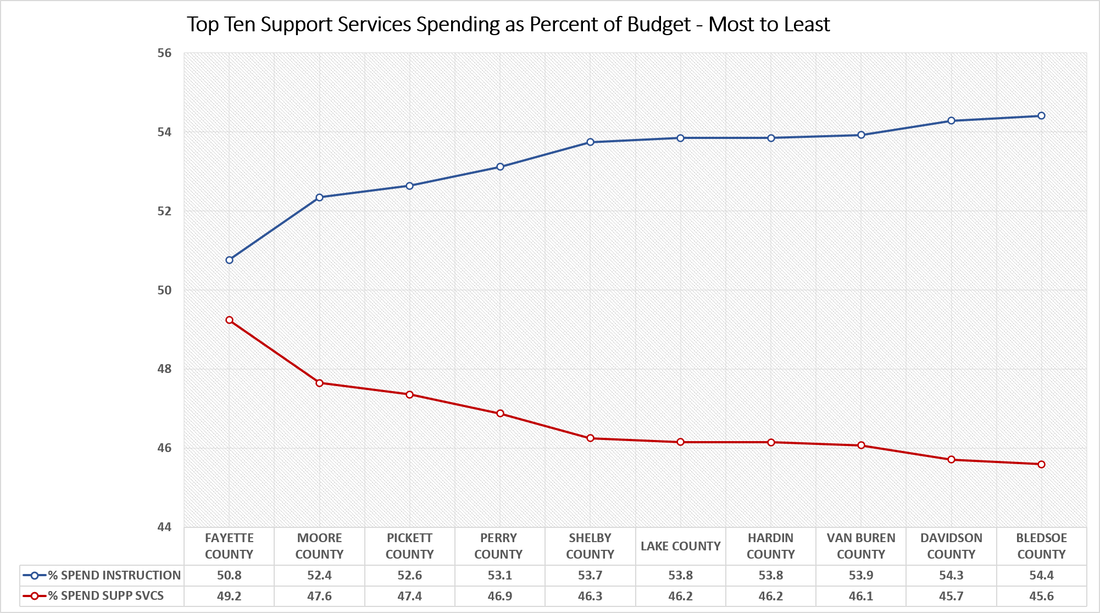
Back to Blog
In Part 3, a comparison of "Instruction" and "Support Services (Overhead)" spending demonstrated that FCPS spends a far higher percentage of the budget on "Support Services" than other County school systems of similar size and budget. Part 4 focuses on a ten-year pattern of spending as well as a comparison of academic performance over that time, including COVID. The chart "Percent Spending Instruction vs Support Services and 3rd Grade RLA/ELA Results" shows trends for spending on teachers and classroom "Instruction" versus other, non-classroom related, "Support Services." The spending lines are complemented by a 3rd Grade RLA/ELA trend over ten years. It is easy to see downward trending in scores as the percentage of spending on Support Services increased and that of Instruction decreased. While it appears that COVID did have some impact on the scores, the overall trend was already going in a negative direction as Support Services spending moved upward. In 2016, there was a transition from RLA (Reading/Language Arts) to ELA (English Language Arts). The 2016 data shows "suppressed" in the state database and no 3rd Grade data is available. Because of school closures in 2020, no data is available for 2020. Viewing the linear trend lines (dashed red lines) in the chart, in 2013 when spending was fifty-five percent Instruction and forty-five percent Support Services, 3rd Grade RLA scores were significantly higher. As the percentage of spending on Instruction decreased, scores began to sink lower. In 2017, following the change from RLA to ELA, scores plummeted. However, at the same time, Support Services spending moved up to forty-eight percent while Instruction spending moved down to fifty-two percent. Spending fluctuated in 2020 and 2021, but in 2022 it reached fifty-one percent Instruction and forty-nine percent Support Services. The 2023 spending data is not yet available so that information cannot be shown at this time. In 2023, FCPS was ranked #94 out of 95 counties in 3rd-8th Reading and the composite of all factors resulted in a Fayette County rank of #95 of 95 counties for Education in the Tennessee "2023 County Profiles." 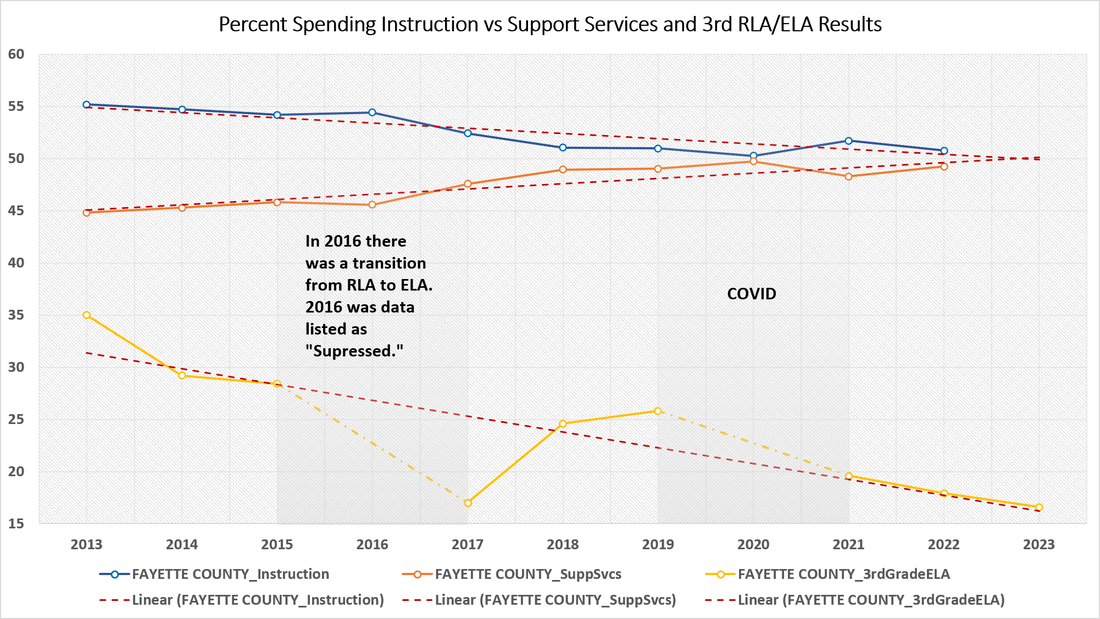 The following chart, "3rd Grade ELA Results over 10 Years," shows how all the Counties in the study have performed over the past ten years. This includes a transition from RLA to ELA in 2016 and COVID in 2020. There are some important points to note:
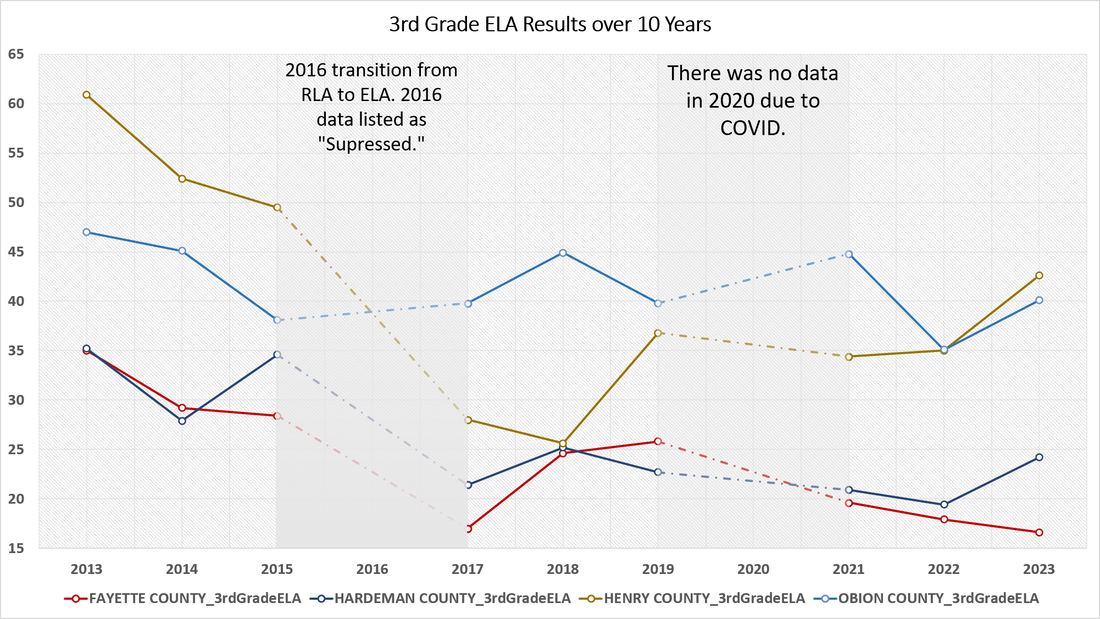 It is important to note the marked improvement of all counties in 2023 except for FCPS. Even considering the redo, apart from whether a redo was done in other counties, FPCS still has the lowest 3rd Grade ELA scores.
An important consideration is that FCPS spends significantly more on Support Services and less on Instruction as a percentage of the budget when compared to other counties. This translates to lower teacher pay, which makes it difficult to hire and retain good teachers. Consequently, this is likely an important factor in the state of Tennessee’s current ranking of FCPS as #95 of 95 county school systems in Tennessee.
Back to Blog
"Part 3" covers how money is spent on "Instruction" versus "Support Services." In general, "Instruction" is classroom-related spending such as teachers, materials, and textbooks, while "Support Services" can be viewed, to some degree, as administrative overhead. Although there are some aspects of "Support Services" which provide necessary services, like Operations and Maintenance of the Plant (Facilities), Transportation, Health, and Food Services. In addition, there are some "Support Services" administrative functions which are required as well. The first chart, "Instruction vs Support Services Spending," covers the overall spending for the counties. The column on the left of the chart shows the categories of spending included in each of the "INSTRUCTION" and "SUPP SVCS" items the TDOE rolled into the "Total Current Expenditures (Table 50 ***)" spreadsheet. While the chart is somewhat busy, there are some key takeaways:
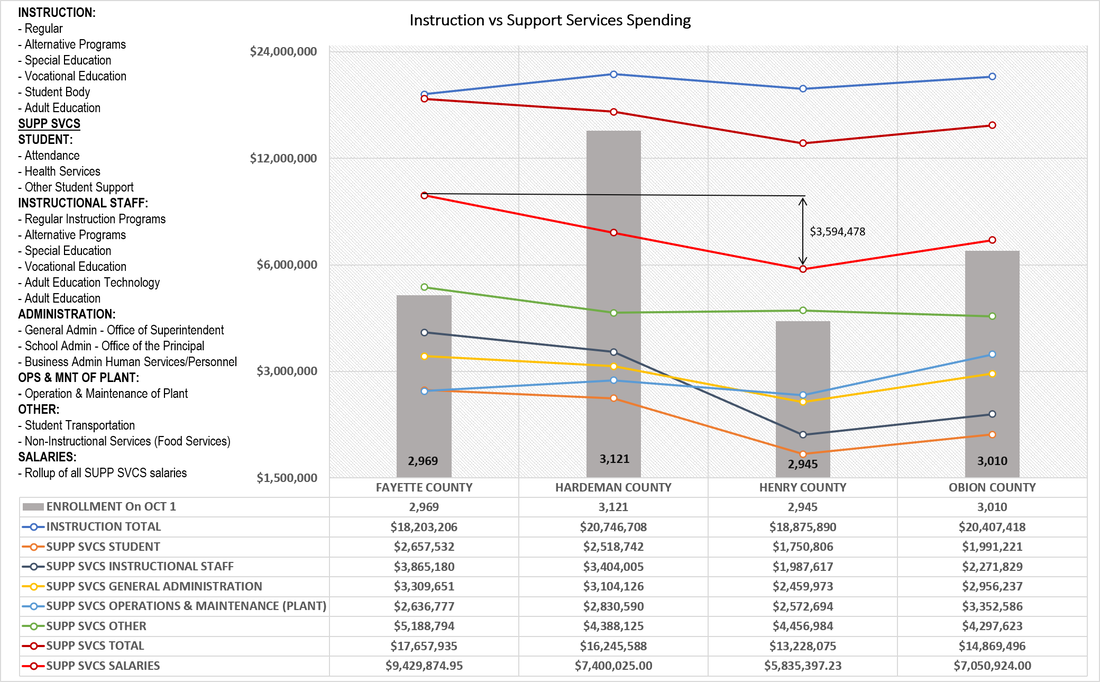 One of the spending categories which stands out is "SUPP SVCS OTHER." One significantly disparate component is "Student Transportation." The chart "Support Services Transportation Buses and Personnel vs Cost" shows how much counties spend on Student Transportation. "TRANSPORTATION TOTAL (grey line)," the total of all transportation items which shows that FCPS spends between $768,707 and $996,750 more than other counties. Even though Fayette County covers more square miles, all of the counties in the study spend similar amounts on "FUEL AND LUBRICANTS (green line)." There is some variance in "PARTS, OTHER MATERIALS & EQUIPMENT (blue line)," but those differences can be attributed to the age and number of buses in the counties. However, there is a large disparity in the number of "TRANSPORTATION PERSONNEL (light blue bar)" as well as "SALARIES SUPERVISORS/DIRECTORS and OTHER (dark red line)." Hardeman County has 105 buses and 57 transportation personnel, while FCPS has 53 buses and 78 transportation personnel. The salary differential between Hardeman and FCPS is $517,066. Even more striking is the difference compared with Henry County, the most similar in size and budget, which has 92 buses and 40 transportation personnel. The transportation salaries in Henry County are $664,915 less than FCPS. One other area that seems incongruent is "OTHER (orange line)." FCPS spent $206,802, but the spending across other counties was between $34,847 and $41,018. While these are not large numbers, it is statistically unusual and, when coupled with the extraordinary spending in personnel salaries, the difference is noteworthy and warrants further review. In addition, though FCPS has 78 transportation personnel and 53 buses, there are students that must catch a bus at 5:27 AM. Even worse, they must endure a 1 ½ hour bus ride to and from school. One and one half (1 ½ ) hours is the limit according to Tennessee state law (TCA 49-6-2105 Maximum time in transit). The need to get up early enough to catch a bus at 5:27 AM in conjunction with the length of time on the bus has clear implications with regard to mental acuity and, consequently, academic performance. This is also worthy of additional scrutiny. 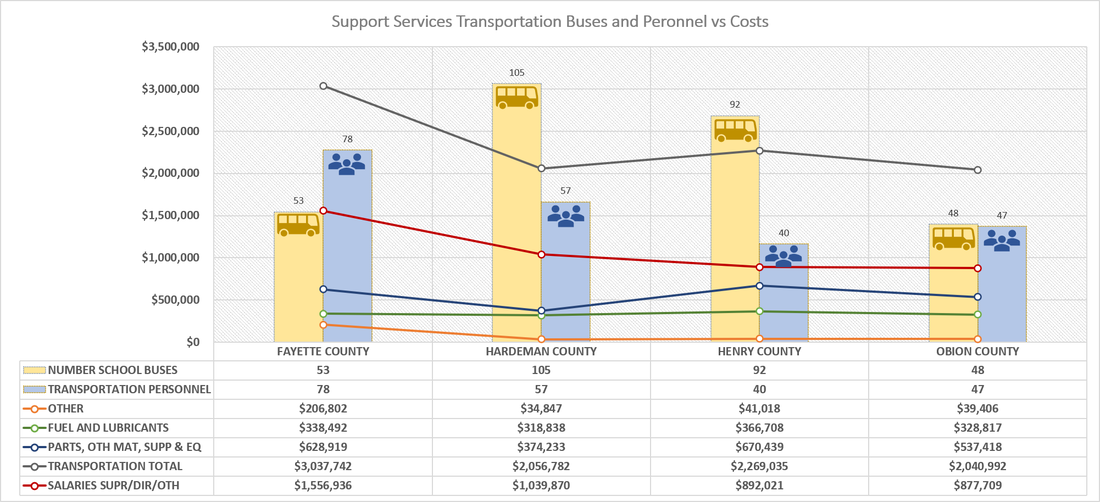 In "Part 4", it will shown that there is a correlation between lower 3rd Grade ELA scores and higher "Support Services" spending.
*** - https://www.tn.gov/education/districts/federal-programs-and-oversight/data/department-reports/2022-annual-statistical-report.html
Back to Blog
Part 2 focuses on "Teacher Pay" and how Fayette County Public Schools (FCPS) compares to other counties of similar enrollment and funding. 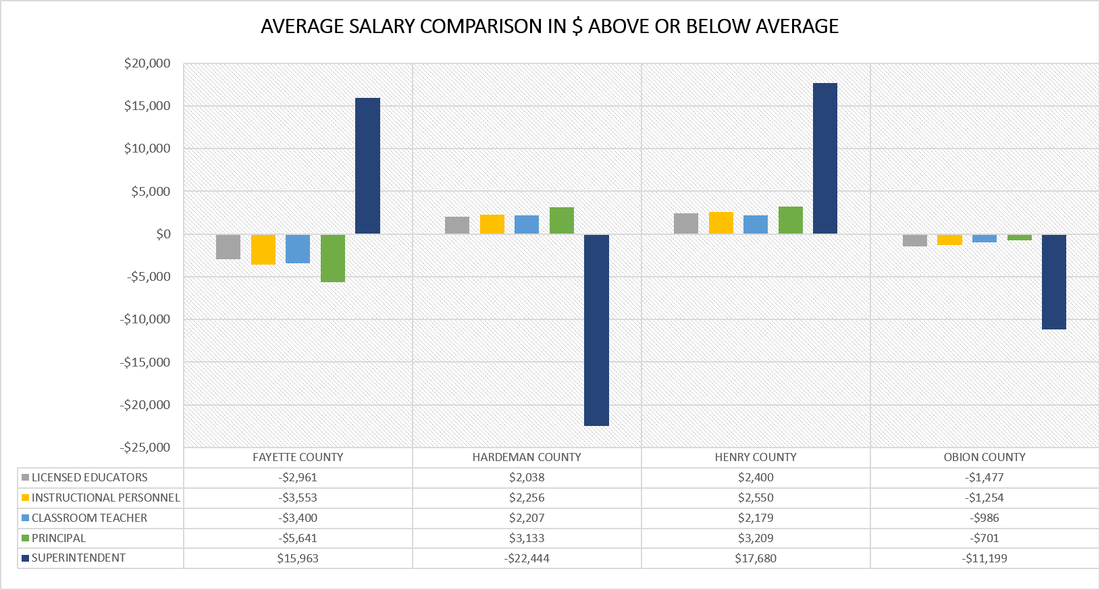 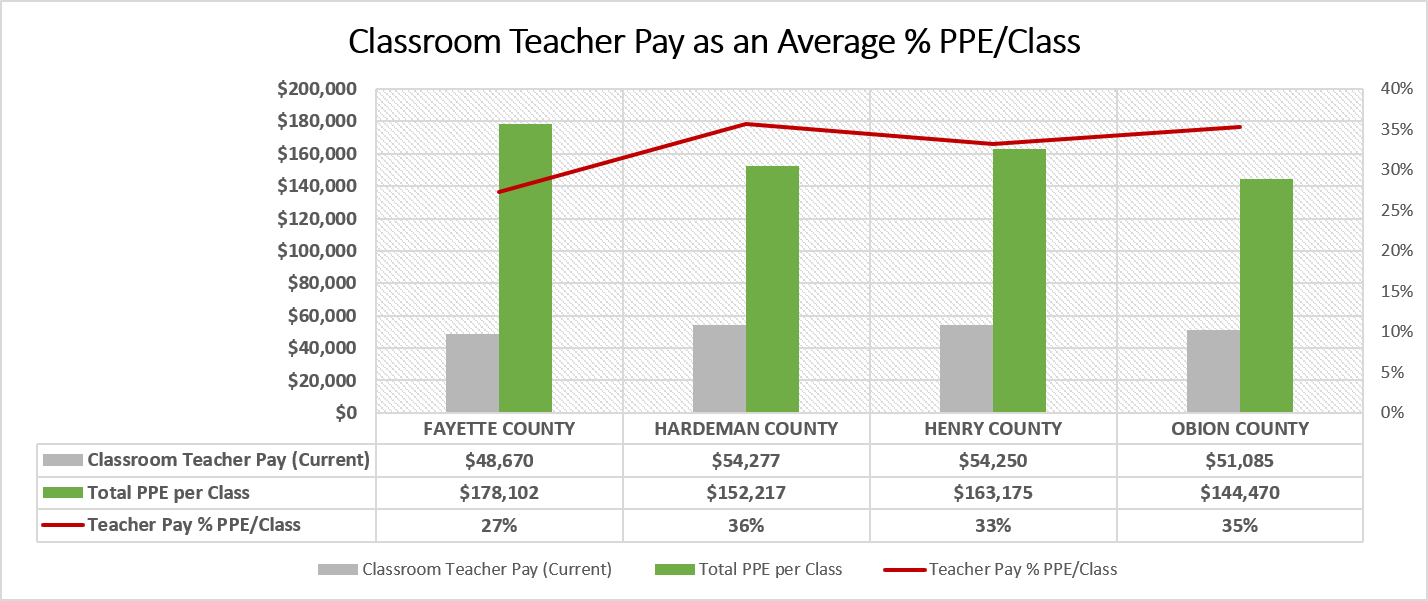
Back to Blog
This is a very important subject to explore and thoroughly understand. As a County Commissioner here in Fayette County TN, I feel that taxpayer monies must be spent wisely and provide the best return on investment (ROI) for taxpayers. Our first obligation is Public Safety, Law Enforcement, Fire Fighting, and EMS. But we have other state required obligations such as Public Works (roads) and Public Schools. 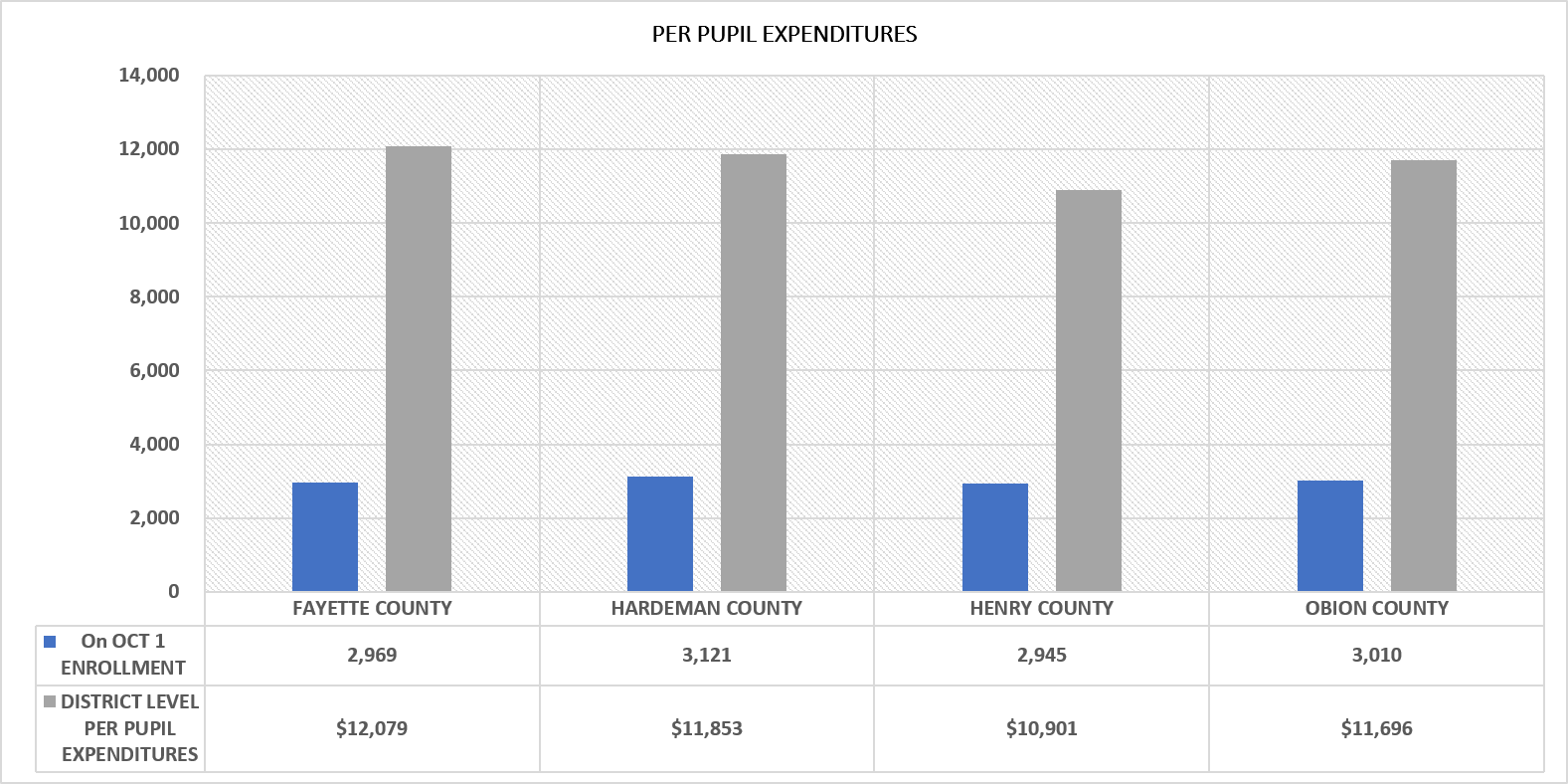 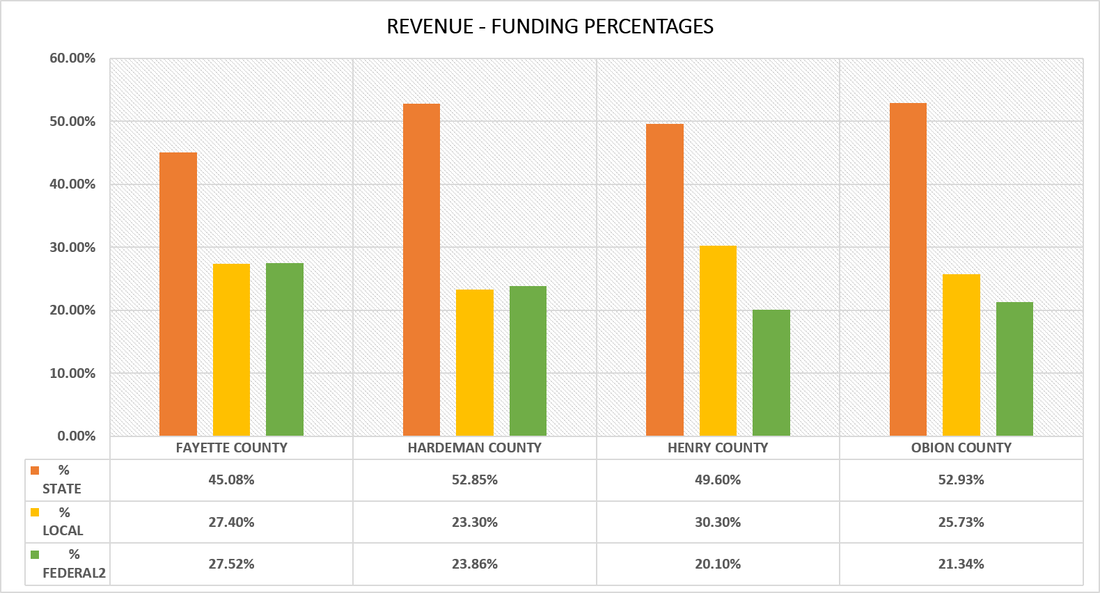 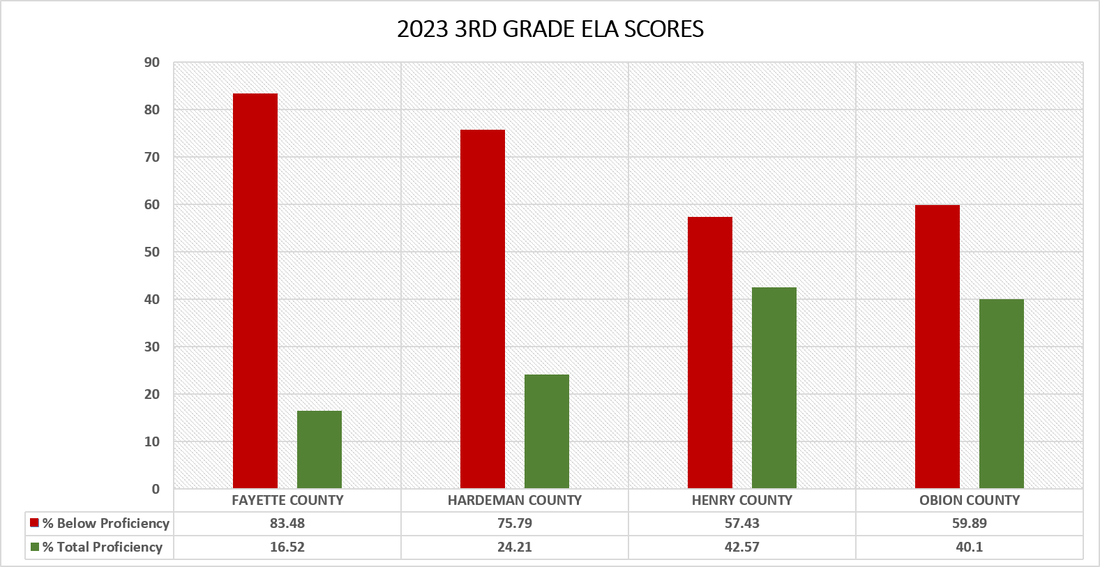 |

 RSS Feed